

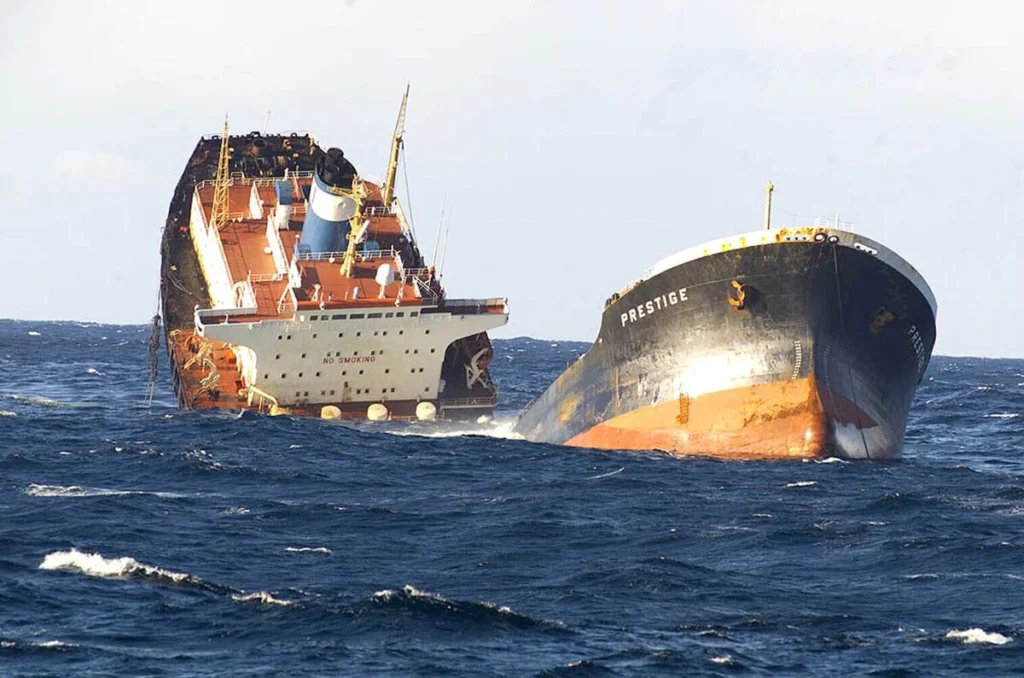
Jurisdictional conflicts are a recurring challenge in international maritime incidents, and the Prestige case stands as an example of how legal disputes can become even more complex when appeals are involved.
This landmark case highlights how arbitration clauses, state immunity, and international conventions intersect, creating a web of legal challenges that appeals tend to exacerbate. The involvement of multiple jurisdictions, coupled with differing interpretations of international laws, not only delays resolutions but also amplifies uncertainties for key stakeholders such as insurers, shipowners, and states.
In this post, we will explore the multifaceted role of appeals in these conflicts, analyzing their impact on legal timelines, stakeholder dynamics, and the overall effectiveness of international maritime dispute resolution.
1. The Prestige case and the origin of the conflict
The sinking of the oil tanker Prestige in November 2002 off the coast of Galicia triggered one of the most devastating environmental disasters in recent history. Following the incident, numerous claims emerged, ranging from pollution damages to disputes over the civil liability of the parties involved, including the shipowner, captain, insurers, and reinsurers. These disputes were further complicated by the transnational nature of the event, which raised significant challenges in determining which jurisdiction had authority over the case.
The case involved prolonged legal battles across multiple countries, including Spain, France, Greece, and England, with disputes often escalating to higher courts through a series of appeals. These appeals not only sought to overturn unfavorable rulings but also to reinterpret critical aspects of liability and the application of international conventions.
In Spain, the nation most affected by the disaster, the case was initially handled by Galician courts, which assumed jurisdiction due to the location of the most severe environmental damage. In 2013, more than a decade after the sinking, the Provincial Court of La Coruña issued a controversial ruling absolving the ship’s captain, Apostolos Mangouras, and the shipowner of criminal liability. This decision was appealed by the Spanish State and other parties. Finally, in 2016, Spain’s Supreme Court partially overturned the ruling, holding the captain criminally responsible for environmental crimes and declaring both the shipowner and its insurer civilly liable for the damages. While this marked a turning point, it did not fully resolve the ongoing legal disputes.
In France, courts became involved due to pollution along its coastline. Although French courts did not play a central role in the claims process, they faced significant challenges interpreting international conventions, particularly the International Convention on Civil Liability for Oil Pollution Damage (CLC 1992). These disputes underscored the difficulties of coordinating legal efforts across jurisdictions affected by the same maritime incident.
In Greece, the case gained attention due to the nationality of the captain, Apostolos Mangouras, and his detention in Spain. Internationally, appeals regarding his criminal liability sparked debates over jurisdiction, the proportionality of bail measures (initially set at €3 million), and his eventual conviction. These issues drew criticism from international human rights organizations, which questioned the treatment of Mangouras and highlighted the broader implications for maritime workers.
In England, the case became a focal point for contractual disputes involving insurers and reinsurers. England’s legal system, a prominent hub for maritime arbitration and litigation, hosted key proceedings regarding insurance coverage, contractual obligations, and the interpretation of international agreements. The shipowner’s primary insurer, The London Steam-Ship Owners’ Mutual Insurance Association (London P&I Club), headquartered in England, became embroiled in disputes over the application of arbitration clauses in the insurance contracts. England also served as the venue for litigation on the interpretation of the CLC 1992 and the scope of its liability limits. These proceedings often highlighted the insurers’ efforts to limit financial obligations, creating tensions with courts in other jurisdictions, particularly Spain, which sought broader compensation for the damages caused by the disaster.
Beyond the national-level disputes, the Prestige case underscored the limited effectiveness of international dispute resolution mechanisms. While frameworks like the CLC 1992 and the 1992 Fund provide guidance for oil pollution claims, disagreements over their interpretation and application caused significant delays in compensating affected parties. The fragmented legal processes and jurisdictional conflicts revealed the difficulty of achieving uniform application of international conventions in complex, transnational maritime incidents.
2. The role of appeals in jurisdictional conflicts
In the context of international maritime claims, appeals are a critical tool for parties seeking to defend their interests. However, they also present significant challenges to resolving jurisdictional conflicts, particularly in the following areas:
2.1. Procedural delays
In the Prestige case, appeals filed by the captain, the shipowner, and insurers prolonged the litigation for over a decade. The Spanish Supreme Court, for instance, did not issue a final decision on liability until 2016—fourteen years after the incident. This ruling partially overturned earlier decisions by the Provincial Court of La Coruña, declaring the shipowner and its insurer, The London P&I Club, civilly liable for damages and holding Captain Apostolos Mangouras criminally responsible for environmental crimes. The final decision imposed substantial compensation obligations, including €1.5 billion in damages to the Spanish State. These protracted legal battles not only delayed environmental restoration but also severely impacted local communities, such as fishermen, who depended on timely compensation for their livelihoods.
2.2. Conflicts between national and international courts
Appeals across different jurisdictions often exacerbate conflicts when courts interpret international conventions in inconsistent ways. In the Prestige case, one of the central debates was determining which court held jurisdiction to rule on liability and how to apply the CLC’s compensation limits. For example, Spanish courts argued that the environmental damage warranted broader compensation under national law, whereas English courts focused on enforcing arbitration clauses and liability limits as defined by the CLC. The Spanish Supreme Court’s ruling in 2016 clashed with earlier interpretations by English courts, underscoring the challenges of harmonizing legal frameworks in transnational disputes.
2.3. Impact on insurers and reinsurers
Appeals introduce significant legal uncertainty for insurers and reinsurers, making it difficult to assess financial exposure while litigation remains unresolved. In the Prestige case, the shipowner’s insurer, London P&I Club, faced years of uncertainty regarding the extent and scope of its liability. Disputes over compensation levels strained relationships with Spanish courts, which sought higher payments to cover environmental restoration and damages to affected communities. For instance, the insurer’s stance on limiting payouts under the CLC framework created tensions with Spain’s broader claims for damages, further complicating the resolution process.
3. Lessons learned and practical recommendations
The Prestige case offers key lessons on the impact of appeals in maritime jurisdictional conflicts and how parties can manage them more effectively:
3.1 Clear use of jurisdiction and arbitration clauses
Including specific clauses in maritime contracts and insurance policies can help prevent prolonged disputes over which court has jurisdiction. Contracts should explicitly state the court or arbitration panel that will have jurisdiction. In cases of complex incidents, international arbitration can provide a faster and more efficient resolution.
In addiction, the contracts must clearly define which national or international legal framework will apply to disputes. This is particularly crucial in cases involving multinational stakeholders because ambiguities in arbitration clauses often lead to additional litigation, as seen in the Prestige case, where conflicting interpretations of international conventions prolonged the resolution process.
3.2 Encouraging alternative dispute resolution
Promoting the use of mediation or binding arbitration can help parties offering faster resolutions compared to litigation, and avoiding the lengthy delays often caused by court appeals in maritime cases.
Arbitration panels with maritime law and environmental experts can ensure specialized and informed decisions, particularly in complex, high-profile incidents like the Prestige case.
While this may not always be feasible, particularly in high-profile cases like the Prestige, it can be a valuable tool for managing smaller-scale incidents.
Conclusion
Appeals are a legitimate right in maritime litigation, but they can also become an obstacle to the effective resolution of jurisdictional conflicts.
The Prestige case underscores the pressing need for proactive legal strategies, including the use of clear arbitration clauses, the promotion of alternative dispute resolution mechanisms, and enhanced international coordination to minimize delays and uncertainties in resolving maritime jurisdictional conflicts.
Ultimately, jurisdictional disputes and the appeals they generate highlight the necessity of a more coordinated and proactive approach in international maritime law to ensure better outcomes for all stakeholders involved.
At Marlin Blue, we specialize in providing expert legal consultancy, handling litigation, and offering mediation and arbitration services tailored to the maritime and trade sectors. Contact us today to explore how we can support your business in navigating complex legal challenges efficiently.


